An Analysis in Mebounds
By Billy Fryer in WNBA
July 21, 2025
This Article was originally posted on 7-16-2025 but has a slight miscalculating in mebounds. All numbers and relevant commentary have been adjusted.
In her season and a half in the WNBA, Angel Reese has proven that she is one of the best rebounders in all of basketball. In her own words, “anything that comes off that board is mine”, and that has primarily been true. During the 2024 season, she set the WNBA record for rebounds per game for a single season with 13.1 a game. She also led the league in Rebound % (the number of rebounds she recorded divided by the number of rebounds available when she was on the court). As of the 2025 All-Star Break, she’s kept up that pace averaging 12.6 rebounds a game (which would rank 2nd all-time to her 2024 season) with a Rebound % of 22.6%.
The strongest part of her game is her Offensive Rebounding. Angel Reese averaged 5.1 OREB/Game in the 2024 season which is tied with Yolanda Griffith’s 2001 Season for best all time. However, Reese’s season came under much more scrutiny than Griffith’s ever did due to her poor FG%, specifically close to the basket. In 2024, Reese went 147 for 357 (41.1%) on the season within 10 feet of the basket. It seemed to most fans that a majority of her offensive rebounds were off her own misses. This led to Ben Hendricks coining the term “mebound” on Jeff Teague’s Podcast Club 520, a term Reese has since trademarked for merchandise according to the Athletic. To define the term, a mebound occurs when a player takes a shot and misses (including shots that are blocked) and then proceeds to get their own offensive rebound. Although Angel Reese is the most famous mebounder, I wanted to study where she compares historically to other mebounders as well as how they may or may not artificially inflate her other statistics.
Note: Unfortunately, the WNBA API did not have data prior to the 2002 season, which leaves us wondering if Griffith’s 2001 season was obtained by poor teammate shooting or by her own misses. All references in this article to “all-time” records should be interpreted as “since 2002”. That being said, due to the increasing number of games per season the WNBA has had since its inception, it’s fair to conclude that all “totals” statistics are likely to be true “all-time” records.
Mebounds throughout WNBA History
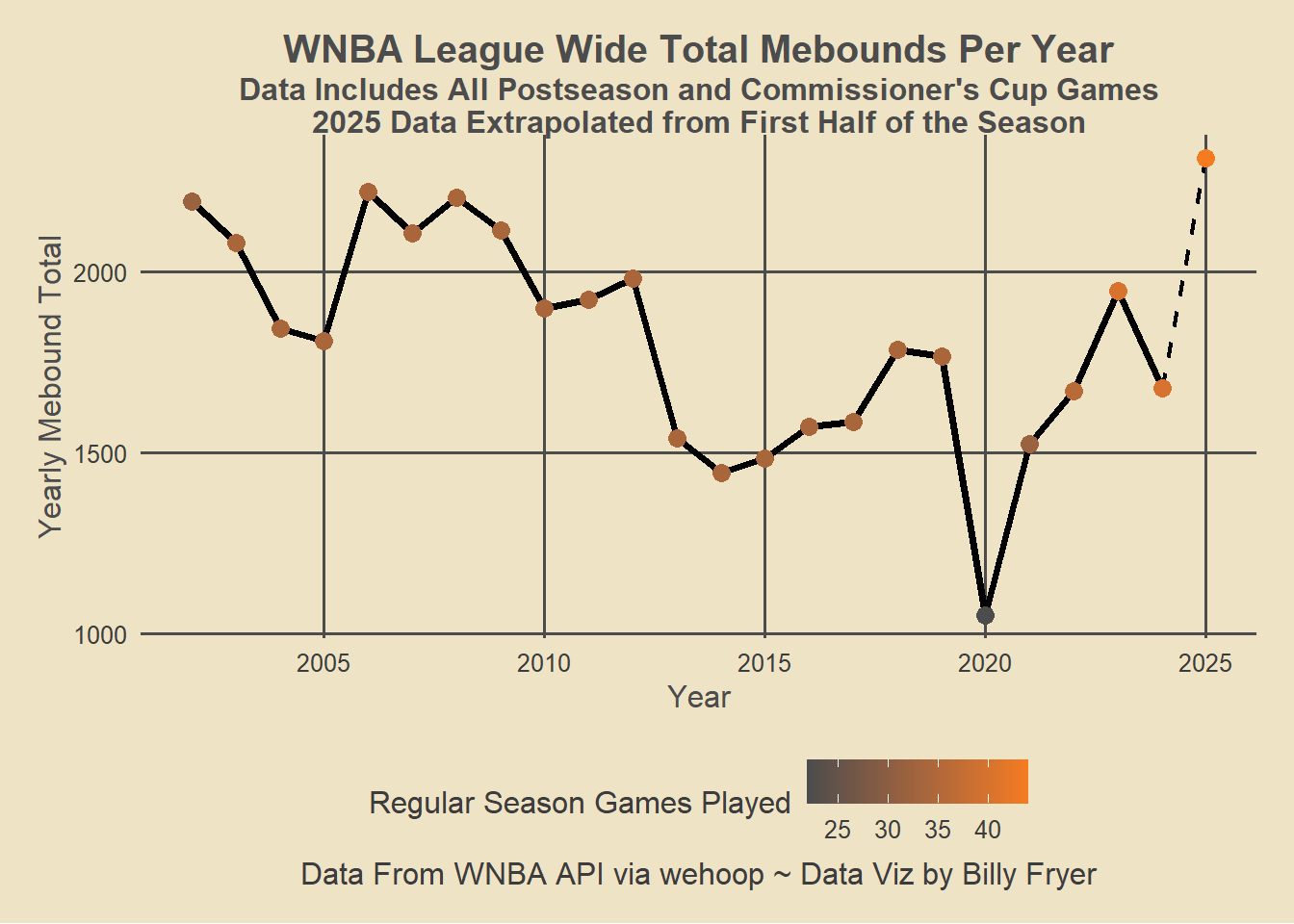
As the graph above shows, the WNBA is on pace to shatter the league record of mebounds in a season. This of course makes perfect sense give the expansion of Golden State and the longest season to date with each team playing 44 games. The total amount of mebounds per year in the league is typically between 1500 and 2000; the 2025 season is projecting to have well over 2000. The notable outlier of course is the 2020 season in the Wubble where teams only played 22 games each and an abbreviated playoff.
Most Notorious Mebounders since 2002
| Top 10 Players by % MEREB | ||||
| % MEREB = MEREB / REB ~ Minimum 20 MEREB | ||||
| Year | Player | REB | MEREB | % MEREB |
|---|---|---|---|---|
| 2023 | Maddy Siegrist | 65 | 26 | 40.0% |
| 2025 | Maddy Siegrist | 57 | 20 | 35.1% |
| 2002 | Jessie Hicks | 100 | 33 | 33.0% |
| 2007 | Latasha Byears | 76 | 25 | 32.9% |
| 2008 | Vanessa Hayden | 105 | 33 | 31.4% |
| 2012 | Lynetta Kizer | 64 | 20 | 31.2% |
| 2009 | Rashanda Mccants | 68 | 21 | 30.9% |
| 2012 | Angel Mccoughtry | 136 | 41 | 30.1% |
| 2006 | Demya Walker | 129 | 38 | 29.5% |
| 2002 | Adrienne Goodson | 197 | 58 | 29.4% |
| Data from 2002 to All Star Break 2025 | ||||
| Data From WNBA API via wehoop ~ Data Viz by Billy Fryer | ||||
Similar to Josiah Cohen’s article, I also decided to look at the proportion of a player’s rebounds that were mebounds (MEREB) rather than a true MEREB% which would be the percentage of Player X’s misses acquired by them self as opposed to the percentage of Player Y’s misses acquired by them self. I did so to make sure I’m not excluding players that may be poor rebounders overall, yet still good at getting their own misses. After setting a minimum qualifier of 20 MEREB on the season, we find that of Angel Reese doesn’t even appear on the list. Although she has achieved notoriety for her mebounds, she’s a strong rebounder overall. On the flip side, Dallas Wings’ post player Maddy Siegrist has had 2 of the highest % MEREB seasons in WNBA history.
How Angel Reese’s Performance has been Boosted by Mebounds
| 2024 Top WNBA Mebounders | |||||
| Player | OREB | MEREB | Rank | PTS Off MEREB | Rank |
|---|---|---|---|---|---|
| Angel Reese | 163 | 91 | 1 | 84 | 2 |
| Teaira McCowan | 107 | 69 | 2 | 90 | 1 |
| Aliyah Boston | 116 | 66 | 3 | 82 | 3 |
| Tina Charles | 94 | 65 | 4 | 76 | 4 |
| Brionna Jones | 92 | 53 | 5 | 72 | 5 |
| Nnemkadi Ogwumike | 67 | 45 | 6 | 52 | 7 |
| Napheesa Collier | 97 | 44 | 7 | 53 | 6 |
| Jonquel Jones | 94 | 44 | 7 | 50 | 9 |
| A'ja Wilson | 76 | 43 | 9 | 52 | 7 |
| Kamilla Cardoso | 81 | 42 | 10 | 48 | 10 |
| Data from 2002 to All Star Break 2025 | |||||
| Data From WNBA API via wehoop ~ Data Viz by Billy Fryer | |||||
As previously mentioned, Angel led the league by a wide margin for most total mebounds in 2024. This is likely strongly connected to the fact that Reese was also the most blocked player in the WNBA. According to WNBA Stats, 76 of Reese’s shots during the 2024 season were blocked. Reese is back to the basket post player, playing well below the rim even compared to other WNBA centers and stands at 6’3”. When playing against giants like Jonquel Jones and Brittney Griner (standing at 6’6” and 6’9” respectively), Reese gives up a huge height advantage with no way to overcome it due to her style of play. While WNBA Rim FG% is lower than NBA Rim FG% for a variety of reasons, the below the rim style of play of Angel Reese lowers her Rim FG% even further leading to even more mebound opportunities on which she capitalizes.
Worth mentioning, despite the wide lead in total mebounds acquired, Reese ranked 2nd in the league for points off of mebounds trailing Dallas Wings’ center Teaira McCowan. Reese only scored 2 points more than Aliyah Boston who is ranked 3rd in the category. This implies that Angel isn’t getting as much of a boost in scoring from the mebounds as previously thought, again due to her below the rim style of play.
| Worst FG% on Shots After MEREB | ||||
| Minimum 20 MEREB | ||||
| Year | Player | MEREB |
Off of MEREB
|
|
|---|---|---|---|---|
| PTS | FG% | |||
| 2014 | Angel Mccoughtry | 25 | 10 | 20.0% |
| 2003 | Plenette Pierson | 22 | 10 | 22.7% |
| 2008 | Tamera Young | 22 | 10 | 22.7% |
| 2010 | Tiffany Jackson | 20 | 10 | 25.0% |
| 2013 | Glory Johnson | 39 | 20 | 25.6% |
| 2006 | Vickie Johnson | 30 | 16 | 26.7% |
| 2006 | Tangela Smith | 27 | 16 | 29.6% |
| 2016 | Erika Desouza | 30 | 18 | 30.0% |
| 2021 | Ezi Magbegor | 20 | 12 | 30.0% |
| 2007 | Camille Little | 23 | 14 | 30.4% |
| Data from 2002 to All Star Break 2025 | ||||
| Data From WNBA API via wehoop ~ Data Viz by Billy Fryer | ||||
This leads to another point of criticism for Reese: her FG% on shots after mebounds. Despite out mebounding than opponents, Angel’s scoring efficiency after mebounds has been pretty poor. Luckily for her, this is not historically poor as she does not crack the bottom top worst field goal percentages on shots after MEREB. That distinction belongs to Glory Johnson during her 2013 All-Star Campaign with the Tulsa Shock. That All-Star appearance was the first of 2 in her career. Perhaps more surprising is the number of current or future Hall of Famers that appear on this list including Tamika Catchings, Maya Moore, and Alyssa Thomas among others. Angel Reese’s FG% after a MEREB in 2024 was 46% which ranked 29th worst all time. She’s even improved on this number in 2025 shooting over 51% after a MEREB as of the All-Star Break.
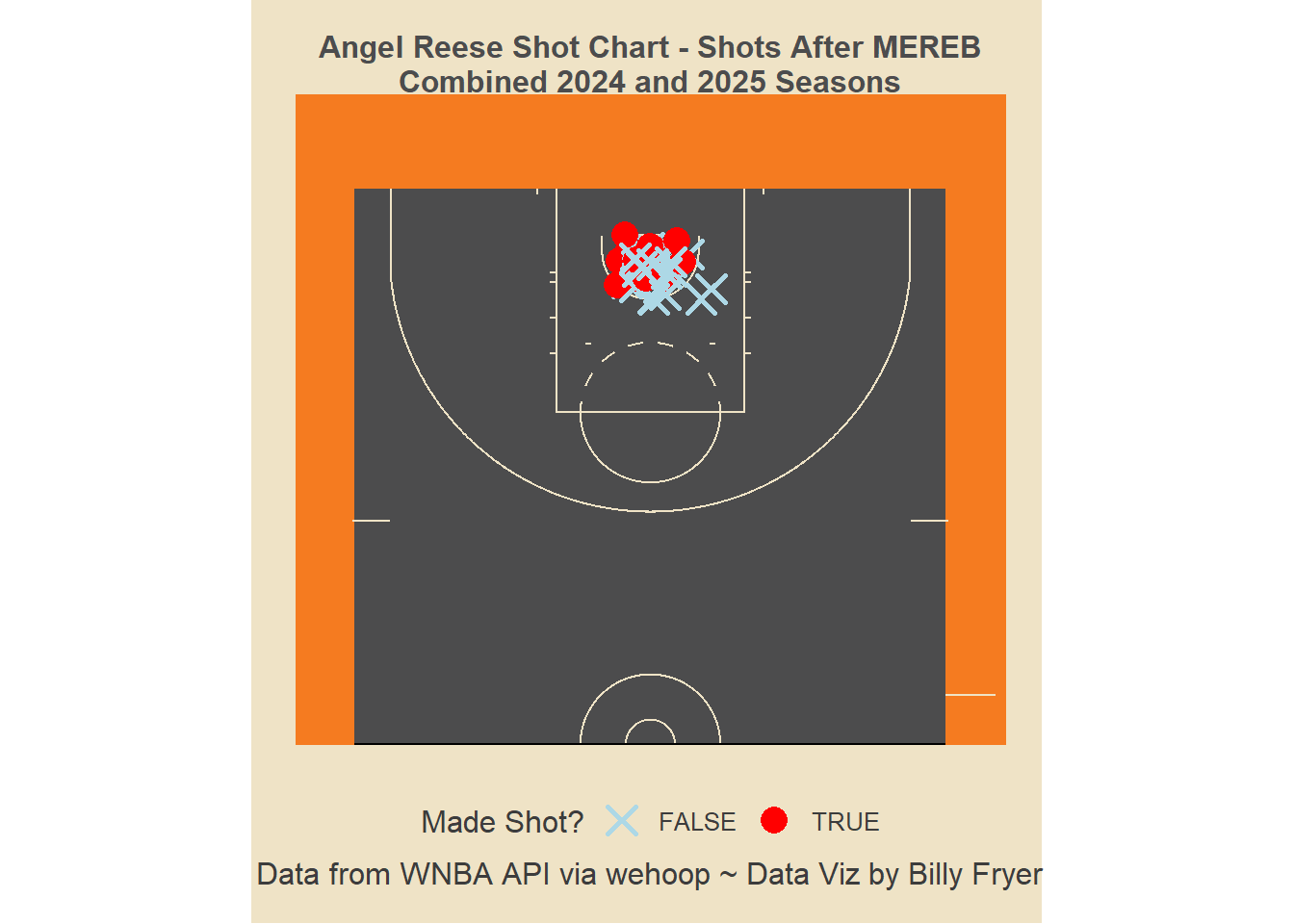
Perhaps more interesting is Reese’s splits for where she makes shots after a mebound. As expected, all her shot attempts after a mebound come right around the rim. However, there is a huge difference in how she finishes on the left side of the rim when compared to the right side. Reese is left-handed, but this split is rather extreme. For her game to improve she needs to be able to finish better with both hands. In conclusion, Angel Reese is an elite mebounder, however she has not established herself as the best mebounder of all time yet. Ultimately, her finishing after acquiring mebounds needs to improve before we should consider her mebounds as “stat padding”.
Stats sourced from Basketball Reference unless otherwise stated.